
Honorary Citizen
Two complaints in twenty-eight months
and the building inspector says
the two-foot Jedi has to go inside.
But this is Tennessee’s oldest town,
where the power lines run underground
so nothing spoils the 1700s view,
and 1,779 signatures say otherwise—
the same year the town was founded.
The candy shop owner wheels Yoda
into the Board of Mayor and Aldermen
meeting. Unanimous vote. Honorary citizen.
Nine hundred years old and finally
he belongs somewhere.

Photo by Tucker Riggins
Tweetsie
They called it Eat Taters & Wear No
Clothes, the narrow-gauge line too tight
for standard rails, built to squeeze
through mountain switchbacks
no other train could navigate.
Conductor Cy Crumley punched
tickets with a heart-shaped hole,
let folks ride free during the
Depression, delivered groceries and
coffins
and moonshine better than Jim Beam.
The floods of 1940 washed out the
tracks. October 1950: last freight run,
the whistle’s tweet-tweet
swallowed by the hollers.
Now the right-of-way is crushed
stone, ten miles for bikes and runners
and a storybook trail for children
who will never hear that whistle
except in the name kept.

Room 311
The bars stayed on these windows
after fire code took them down everywhere
else— vacant and haunted, no one to trap.
Which made it perfect for Capone in
’31, en route to Chicago, tax evasion
trial, two guards on the roof, two in the
hall.
They put a murderer in the room
where a murder had happened.
Four years earlier: Annalisa Netherly, married,
bored, her husband gone on business. She
found the billiards room. Sparks flew. He
found out on a northbound train,
drunk passengers bragging.
Straight razor off the counter.
She was bathing.
Now the vacuum tube radio
plays 1920s swing at 3 a.m.
and guests complain to the front
desk who swears they didn’t turn it on.
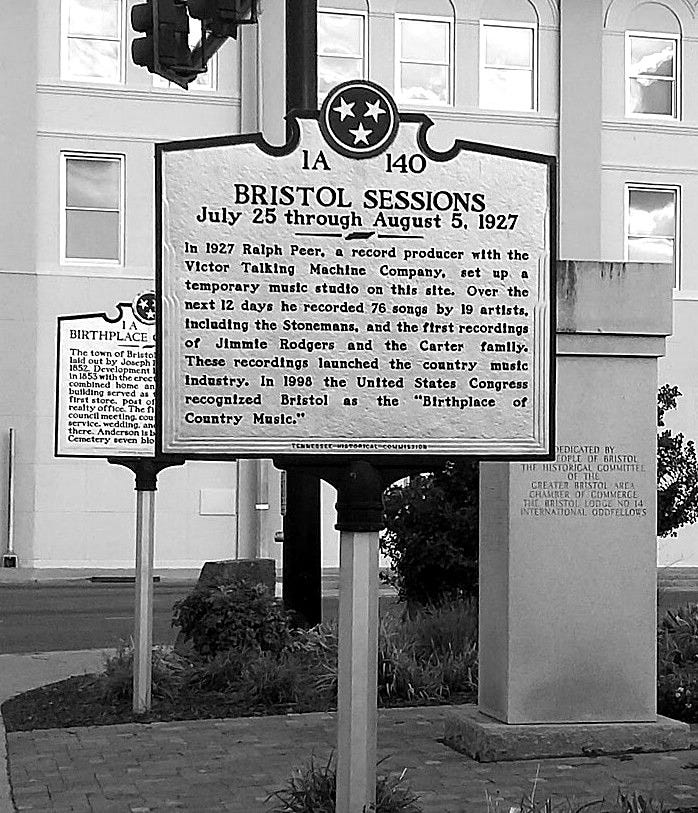
State Line
In Bristol, the border runs
down the center of Main Street—
Tennessee on one side,
Virginia on the other,
brass medallions in the pavement
marking where you stand.
Two states, one state of mind,
the signs say.
In 1927, Ralph Peer set up
a portable recording studio
and cut the Bristol Sessions—
the Carter Family, Jimmie Rodgers,
the big bang of country music
pressed into shellac.
I cross back and forth
a dozen times before lunch,
state to state to state,
like the borders mean nothing,
like they’re just lines we agreed on.

Eighty-Three Flavors
The taffy comes in eighty-three flavors
and the kids go straight for sour,
the grandmothers for nostalgia—
Bit-O-Honey, Necco Wafers,
the wax lips they haven’t seen in decades.
Upstairs, Pac-Man bleeps.
Pong. Space Invaders. Tron.
Seventy-five machines from the decade
we thought the future would be different.
The owner opened this shop
the year the dot-com bubble burst,
six months before the towers fell.
He’s survived 9/11, the crash of ’08,
COVID, a hurricane that closed the interstates.
This is what a candy store can do:
hold a historic building upright,
give three generations something
to talk about in the same room,
keep Main Street from becoming
another row of lawyers and accountants.
Author’s note:
This past August, I spent time reporting in northeastern Tennessee—a region that rarely makes the travel pages. I was there to write destination pieces, but what I found were stories about holding on: a candy shop owner who wheeled a two-foot Yoda statue into a town council meeting after two complaints nearly forced it off the sidewalk; a rails-to-trails path named for a train whistle no one alive has heard; a hotel room where the radio allegedly plays 1920s swing in the middle of the night, nearly a century after a woman was murdered there.
I’m drawn to places where history and legend blur, where the documented and the allegedly coexist. These poems live in that space.
Tamara MC, PhD, is the 2025 Lowell Thomas Travel Journalist Bronze Grand Award winner. Her work appears in The New York Times, Newsweek, BBC Wildlife, Texas Monthly, SLATE, Salon, and 90+ publications. She has two books forthcoming in 2027: Oldest Tucson (Reedy Press) and Poetry for English Language Learning (University of New Mexico Press). An applied linguist who has studied seven languages, she served as a U.S. State Department English Language Fellow and has traveled to 77 countries, mostly solo backpacking. A third-generation Tucsonan, she writes about the weird, wacky, and wonderful.